Dynamic QR Codes vs. Static QR Codes: The Definitive 2026 Guide for Businesses and Marketers
Summary
Quick Response (QR) codes have cemented their position as the essential bridge connecting physical experiences with digital destinations. As businesses across retail, hospitality, enterprise software, and consumer goods scale their print and digital campaigns in 2026, a fundamental technical question emerges: should you deploy a static QR code or a dynamic QR code? Market data demonstrates that dynamic QR codes now represent over 64 percent of all real-world implementations and more than 98 percent of codes created on professional link management platforms. This comprehensive guide breaks down the core architecture, mechanics, benefits, and limitations of both formats. You will learn how dynamic QR codes eliminate costly reprinting mistakes through instant URL editability, how real-time scan telemetry fuels data-driven marketing, and how modern link intelligence platforms like Wonzly transform simple 2D barcodes into powerful conversion engines.
Estimated Reading Time: 16 minutes
Want the full details? Keep reading below.
What You'll Learn in This Article
| Section | What It Covers |
|---|---|
| The Modern QR Renaissance | Why 2D barcodes have become universal across consumer and enterprise markets. |
| What Is a Static QR Code? | Architecture, direct data encoding, strengths, and permanent limitations. |
| What Is a Dynamic QR Code? | How intermediate redirect servers enable editable destinations and tracking. |
| Feature-by-Feature Comparison | A direct side-by-side analysis of editability, analytics, speed, and cost. |
| Real-World Use Cases by Format | Concrete scenarios where static or dynamic codes deliver the best outcome. |
| Advanced Dynamic Capabilities | Device-based routing, geo-targeting, password protection, and retargeting pixels. |
| Design, Error Correction & Printing Rules | Best practices for sizing, contrast, Reed-Solomon error correction, and scannability. |
| Bridging Physical and Digital with Wonzly | How Wonzly link intelligence powers enterprise-grade QR code workflows. |
| Frequently Asked Questions (FAQ) | Direct answers to top questions about static and dynamic QR technology. |
The Modern QR Renaissance: Why 2D Barcodes Are Essential in 2026
First invented in 1994 by Masahiro Hara of Denso Wave to track automotive components during manufacturing, Quick Response (QR) codes have undergone a dramatic evolution. What began as an industrial tracking matrix has transformed into the primary offline-to-online navigation tool for billions of smartphone users worldwide.
In 2026, native camera integration across all major mobile operating systems (iOS and Android) has rendered specialized scanning applications obsolete. Consumers instinctively point their smartphone camera at restaurant menus, product packaging, transit advertisements, conference badges, and retail receipts to access web applications, complete payments, and redeem promotions.
However, many businesses still make the critical mistake of treating all QR codes identically. Deploying the wrong barcode format on thousands of printed brochures, product boxes, or permanent physical signage can lead to wasted marketing budgets, broken links, and missed customer analytics.
- Universal Consumer Adoption: Over 89 percent of active smartphone users scan at least one QR code each month.
- Physical-to-Digital Bridge: Connects offline print media (billboards, packaging, direct mail) directly to digital funnels.
- High Data Density: Capable of encoding up to 7,089 numeric characters or 4,296 alphanumeric characters.
- Operational Scalability: Enables instant contactless payments, self-service ordering, and frictionless app onboarding.
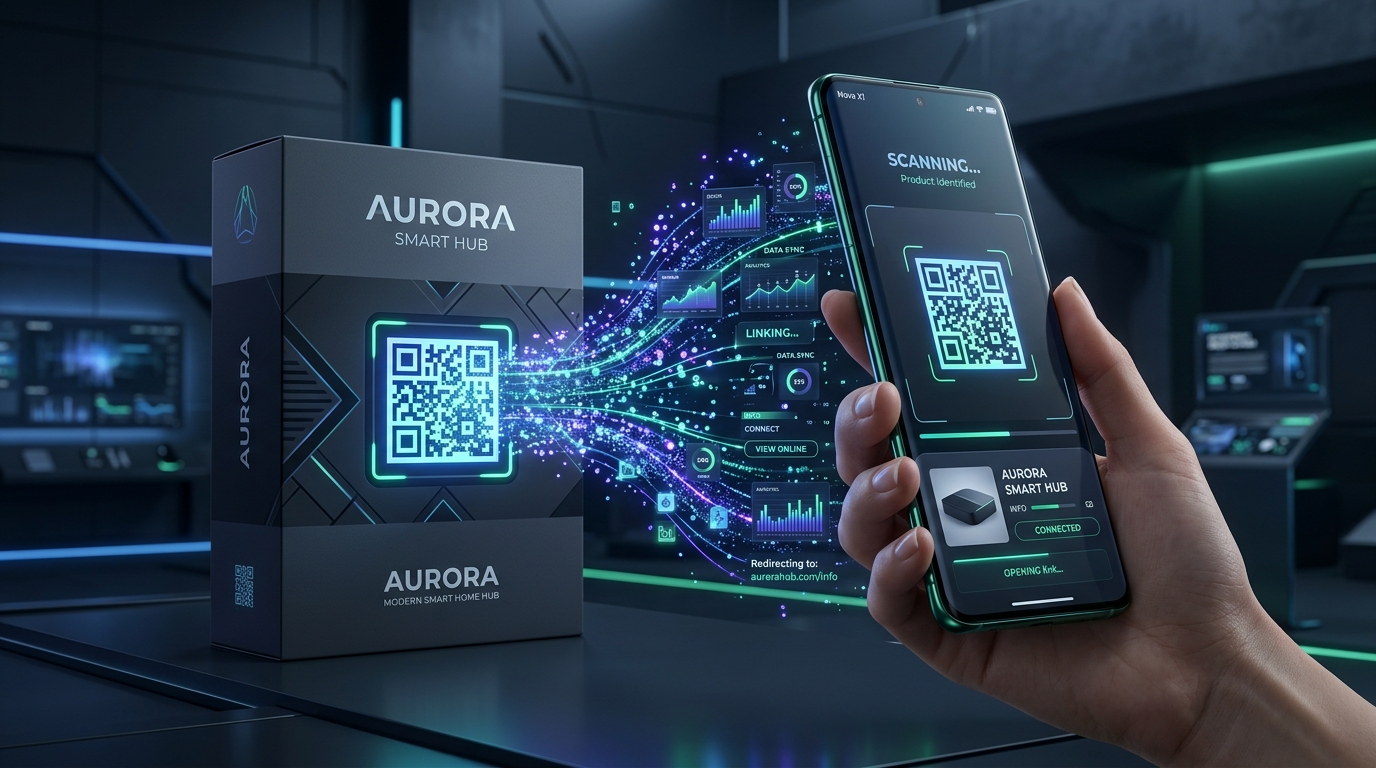 Source: Wonzly Link Intelligence - Real-time contactless scanning and smart routing powered by modern dynamic QR codes.
What Is a Static QR Code? Architecture, Direct Encoding, and Permanent Limits
A static QR code is a two-dimensional barcode where the target information is permanently and directly encoded into the pattern of black and white data modules. Once the static QR code image is generated and printed, its underlying payload is mathematically locked and cannot be edited, updated, or reconfigured under any circumstances.
Because the data is stored directly in the physical module matrix, static QR codes function independently of external cloud servers. When a smartphone camera scans a static QR code containing a plain text string or Wi-Fi network credentials, the phone decodes the binary matrix directly on the device without needing to query a remote database.
While this direct encoding architecture offers advantages for simple, permanent data, it introduces severe limitations for marketing campaigns and enterprise workflows. If you print a static QR code pointing to a webpage that subsequently moves or suffers from a typo, the printed material becomes completely useless.
Static QR Code Architecture & Workflow
| Component | Technical Function | Operational Limitation |
|---|---|---|
| Optical Capture | Smartphone camera scans black & white module grid directly | Requires camera line-of-sight |
| Payload Storage | Full text / URL permanently hardcoded in binary matrix | Cannot be edited or updated after creation |
| Resolution Layer | Decoded directly by mobile operating system offline | Zero analytics, scan counts, or telemetry captured |
| Data Scaling | Grid complexity increases as URL length grows | Longer URLs result in crowded, hard-to-scan modules |
- Permanent Encoding: The destination string cannot be modified once generated.
- Zero Server Dependency: Resolves completely offline for local data like Wi-Fi configurations or plain text.
- No Scan Analytics: Cannot track scan counts, unique visitors, user devices, or geographic locations.
- Matrix Density Scaling: Longer destination URLs produce denser, more complex module grids that are harder to scan from a distance.
What Is a Dynamic QR Code? Intermediate Redirects and Total Flexibility
A dynamic QR code solves the fundamental limitations of static barcodes by introducing an intelligent intermediate redirect layer. Instead of encoding a lengthy final destination URL directly into the barcode matrix, a dynamic QR code encodes a compact, short URL (for example, https://wonzly.link/menu).
When a user scans a dynamic QR code, their smartphone browser requests the compact short URL from the link management server. The server instantly logs real-time telemetry data (such as the scan timestamp, device operating system, browser language, and city-level geolocation) and issues an HTTP 301 or 302 redirect sending the user to the configured destination webpage.
This architectural separation between the physical visual matrix and the digital destination provides unmatched operational flexibility. Marketing teams can update the destination URL at any time via a cloud dashboard without modifying or reprinting the physical QR code.
Dynamic QR Code Redirection & Intelligence Pipeline
| Step | Pipeline Stage | Action Performed | Business Benefit |
|---|---|---|---|
| 1 | Scan Optical Capture | User scans a clean, low-density short URL matrix | Ultra-fast scan recognition |
| 2 | Link Gateway Processing | Request hits Wonzly routing server (wonzly.link/menu) |
Full scan telemetry captured |
| 3 | Rule Evaluation | Server checks device type, location, and schedule | Custom routing applied (iOS vs Android) |
| 4 | Instant 301/302 Redirect | Browser arrives at current destination page | Zero broken links on printed assets |
- Instant Editability: Change the destination link anytime without touching printed materials.
- Deep Scan Analytics: Capture total scans, unique visitors, device types, and geographic distribution.
- Clean Visual Appearance: Short URLs require fewer modules, resulting in a cleaner, faster-scanning code.
- Dynamic Conditional Routing: Direct iOS users to the App Store and Android users to Google Play from a single code.
Static vs. Dynamic QR Codes: Comprehensive Feature Comparison
Choosing between static and dynamic QR codes requires evaluating technical requirements, budget considerations, and long-term campaign lifecycles.
The comparative matrix below outlines the critical distinctions between both formats:
| Feature / Capability | Static QR Code | Dynamic QR Code |
|---|---|---|
| Destination Editability | Impossible (Permanently locked) | Instant (Editable anytime via dashboard) |
| Scan Analytics & Telemetry | None (Zero data collected) | Comprehensive (Location, device, time, IP) |
| Visual Matrix Complexity | Increases with data length (Dense) | Remains clean and compact (Short URL) |
| Scannability from Distance | Lower (Requires high resolution) | Higher (Cleaner module grid scans easily) |
| Server Dependency | None (Works fully offline) | Requires active link management server |
| Conditional Traffic Routing | Not supported | Supported (Device, language, geo-location) |
| Password Protection & Expiry | Not supported | Supported (Set expiration dates & passwords) |
| Typical Cost | Free to generate | Included in link intelligence platforms |
For any commercial application involving printed packaging, public signage, conference handouts, or retail displays, dynamic QR codes represent the industry-standard choice because they eliminate the catastrophic risk of dead links on physical collateral.
- Risk Mitigation: Protects against marketing collateral waste caused by website migrations or broken links.
- A/B Testing: Direct traffic to alternating landing pages to measure conversion performance.
- Campaign Scheduling: Automatically switch destinations based on time of day (such as lunch vs dinner menus).
- Compliance Updates: Update privacy notices and product documentation on existing product packaging instantly.
Real-World Use Cases: Where Each QR Code Format Delivers Maximum ROI
To maximize return on investment, organizations should deploy each QR format according to its inherent architectural strengths.
When to Use Static QR Codes
Static QR codes excel in closed-loop, permanent environments where data never changes and internet connectivity cannot be guaranteed:
- Guest Wi-Fi Authentication: Encoding
WIFI:S:MyNetwork;T:WPA;P:SecretKey;;allows guests to join local networks instantly without internet lookup. - Offline Personal vCards: Printing a permanent contact card containing phone numbers and email addresses directly into the matrix.
- Internal Asset Inventory: Barcodes placed on warehouse machinery containing fixed serial numbers for offline industrial scanners.
- Cryptographic Public Keys: Displaying static blockchain wallet public addresses for peer-to-peer transfers.
When to Use Dynamic QR Codes
Dynamic QR codes are mandatory across modern commercial, marketing, and customer-facing touchpoints:
- Product Packaging & CPG Goods: Direct consumers to user manuals, regulatory disclosures, or warranty registrations that can be updated throughout the product lifecycle.
- Restaurant & Hospitality Menus: Update seasonal dishes, daily specials, and pricing without reprinting physical table cards.
- Event Marketing & Billboards: Track scans across different billboard locations using unique short URLs while pointing to the same ticketing portal.
- App Store Onboarding: Use intelligent device detection to route scanning smartphones to their respective native app stores automatically.
- Wi-Fi Deployment: Use static codes for internal office networks to allow instant password-free access.
- Retail Packaging: Deploy dynamic QR codes to support post-purchase engagement, video tutorials, and reordering flows.
- Trade Shows & Events: Measure booth engagement by reviewing real-time scan analytics during exhibition hours.
- Print Advertisements: Calculate exact cost-per-scan and conversion ROI across print publications and magazines.
Advanced Capabilities of Modern Dynamic QR Codes
Dynamic QR code technology in 2026 has advanced far beyond basic URL redirects. When paired with modern link intelligence platforms, dynamic QR codes serve as sophisticated edge-routing gateways.
Key enterprise capabilities include:
1. Conditional Device-Based Redirection
A single dynamic QR code printed on a promotional poster can inspect the scanning client's User-Agent string. If an iPhone scans the code, the server redirects to the Apple App Store. If a Samsung Galaxy scans the code, the server routes to Google Play. If a desktop camera scans it, the server serves a responsive web app.
2. Time-Based and Scheduled Redirection
Restaurants and entertainment venues can configure scheduled redirect rules. A dynamic QR code on a bar table can route to a lunch menu between 11:00 AM and 3:00 PM, a happy hour drink special between 4:00 PM and 7:00 PM, and a late-night dessert menu thereafter.
3. Granular Retargeting and Tracking Pixels
Dynamic QR redirect endpoints can trigger server-side conversion API events, allowing marketing teams to build custom retargeting audiences on platforms like Meta, Google, and LinkedIn from individuals who scanned physical print materials.
Smart Device & Context Routing Engine
| Scanning Context | Detected Parameter | Dynamic Action Triggered | End Destination |
|---|---|---|---|
| Apple iPhone / iPad | iOS Safari User-Agent | Directs to iOS App Store Listing | apps.apple.com/app/id... |
| Android Smartphone | Android Chrome User-Agent | Directs to Google Play Store | play.google.com/store/apps/... |
| Desktop / Laptop | macOS / Windows User-Agent | Directs to Desktop Web App | https://yourbrand.com/app |
| Evening Scan Hours | Timestamp > 18:00 Local | Serves Happy Hour & Dinner Menu | https://restaurant.com/dinner |
- Smart Device Routing: Deliver platform-specific downloads from a single unified print asset.
- Time-Based Triggers: Automate dayparting for restaurants, events, and seasonal promotional campaigns.
- Password Protection: Secure sensitive digital assets, financial reports, or internal memos behind scan passcodes.
- Scan Throttling & Limits: Automatically expire promotional discount codes after reaching a preset scan ceiling.
Design, Error Correction, and Print Best Practices
A poorly designed or incorrectly printed QR code can fail to scan, leading to customer frustration and lost conversions. Adhering to technical design standards ensures reliable scannability across diverse lighting conditions and mobile devices.
Reed-Solomon Error Correction Levels
QR codes utilize Reed-Solomon error correction algorithms, allowing barcodes to remain fully functional even if partially damaged, smudged, or covered by a custom logo.
The four error correction tiers are:
- Level L (Low): Reconstructs up to 7 percent of damaged data. Best for clean digital screens where the module grid must be as simple as possible.
- Level M (Medium): Reconstructs up to 15 percent of damaged data. The standard default for most general print materials.
- Level Q (Quartile): Reconstructs up to 25 percent of damaged data. Ideal for industrial settings or high-traffic environments.
- Level H (High): Reconstructs up to 30 percent of damaged data. Mandatory when embedding brand logos or visual icons in the center of the QR code.
Critical Print Guidelines
- Maintain Strong Color Contrast: Always ensure dark foreground modules sit on a crisp, light background. Inverted QR codes (white modules on black backgrounds) suffer from scanning failures on older smartphone sensors.
- Respect the Quiet Zone: Leave an unprinted margin of at least 4 modules wide surrounding all four sides of the QR code to prevent interference from adjacent graphics.
- Minimum Sizing Calculation: The universal rule of thumb for print sizing is
Minimum Width = Scanning Distance / 10. For example, a QR code scanned from 1 meter (100 cm) away should have a minimum printed width of 10 cm.
- Error Correction: Use Level H whenever adding custom brand logos to guarantee flawless scanning.
- Quiet Zone: Never crowd the edges of your QR code with text, borders, or background patterns.
- High Resolution Formats: Always export print-ready QR codes in vector formats (SVG, EPS, or PDF) rather than low-resolution PNGs.
- Real-World Testing: Test printed proofs under low-light and high-glare conditions with both budget and flagship smartphones before authorizing large print runs.
Bridging Physical and Digital Worlds with Wonzly Link Intelligence
Managing thousands of dynamic QR codes across diverse marketing campaigns, retail stores, and product lines requires an enterprise-grade link management foundation. Disjointed tools and free generator utilities introduce security vulnerabilities, lack branded domain support, and provide zero data sovereignty.
Wonzly solves these challenges by combining dynamic QR code creation with advanced URL shortening and deep link analytics within a unified platform.
Wonzly Feature Spotlight: Wonzly transforms physical-to-digital touchpoints into intelligent growth channels. Generate custom-branded dynamic QR codes backed by your own custom domain (
qr.yourbrand.com), inspect real-time scan analytics, update destinations in seconds, and automate workflow triggers through enterprise REST APIs and webhooks.
- Custom Branded Domains: Boost user trust and scanning rates by displaying your verified brand domain on every QR redirect.
- Real-Time Scan Telemetry: Track scans by city, country, browser, device, and referral medium in an interactive dashboard.
- Bulk QR Generation: Create and manage thousands of unique dynamic QR codes programmatically via the Wonzly API.
- Zero Broken Links: Update any QR code destination instantly whenever marketing campaigns or target landing pages evolve.
Learn more about architecting scalable link systems by reading our complete guides on what is a URL shortener, enterprise link management infrastructure, and the best link in bio tools for creators.
Frequently Asked Questions (FAQ)
What is the primary difference between a static and a dynamic QR code?
A static QR code encodes the destination data directly into the black and white matrix, meaning it can never be edited or tracked. A dynamic QR code encodes a short redirect URL, allowing you to edit the destination link at any time and capture real-time scan analytics.
Can I track how many people scan my static QR code?
No. Because static QR codes resolve directly on the user device without passing through an intermediary tracking server, it is technically impossible to collect scan counts, user devices, or location analytics.
Why do dynamic QR codes scan faster and easier than static ones?
Dynamic QR codes use short URLs, which contain fewer characters. Fewer characters require fewer data modules in the matrix, resulting in a cleaner, less crowded grid that smartphone cameras can focus on and decode much faster.
What happens if I print a static QR code with a typo in the URL?
If a static QR code is printed with a typo or broken URL, the code cannot be fixed. All printed physical materials (brochures, packaging, signage) must be reprinted, which can be extremely costly.
Can a dynamic QR code route to different app stores based on device?
Yes. Modern link platforms like Wonzly allow you to configure conditional smart routing rules that automatically redirect iOS devices to the Apple App Store and Android devices to Google Play from a single QR code.
Do dynamic QR codes expire?
Dynamic QR codes do not expire as long as your link management account remains active and the associated redirect URL is maintained on the server. You can also configure optional custom expiration dates for time-sensitive promotions.
What error correction level should I use if I add a company logo to my QR code?
You should always use Reed-Solomon Level H (High) error correction, which allows the barcode to recover up to 30 percent of obscured or missing data, ensuring the logo does not prevent scanning.
Ready to Launch Intelligent Dynamic QR Campaigns?
Stop risking your marketing budget on unchangeable static barcodes. Wonzly provides the speed, flexibility, and analytics your brand needs to connect physical touchpoints with high-converting digital experiences.
- Create Your First Dynamic QR Code -> Get Started Free with Wonzly
- Explore Enterprise Link Solutions -> Discover Wonzly Features
- Read More Marketing Guides -> Browse All Wonzly Blog Articles