Surviving the Zero-Click Search Era: How to Win Brand Citations and Referral Traffic in 2026
Summary
The digital marketing industry in 2026 is confronting an unprecedented structural shift: the mainstream normalization of zero-click searches. With Google AI Overviews, ChatGPT Search, and Perplexity answering user queries directly on the search engine results page, the traditional social contract between web publishers and search engines has fundamentally changed. Recent data reveals that over 68 percent of all desktop searches and nearly 77 percent of mobile queries conclude without the user clicking through to an external website. On queries where AI Overviews are actively generated, zero-click rates surge past 83 percent. This comprehensive strategic guide examines why the traditional organic click is declining, how Generative Engine Optimization (GEO) enables brands to secure high-value citations in AI answers, and why building resilient first-party link tracking infrastructure is your most critical competitive advantage.
Estimated Reading Time: 15 minutes
Want the full details? Keep reading below.
What You'll Learn in This Article
| Section | What It Covers |
|---|---|
| The Zero-Click Reality in 2026 | Understanding the data, click drop metrics, and industry transformation. |
| Anatomy of an AI Overview | How search engines extract, summarize, and display answers without clicks. |
| The Information Gain Framework | Why unique perspectives and proprietary data win position zero citations. |
| GEO vs Classic SEO Playbooks | Practical tactics to optimize for both traditional crawlers and LLM engines. |
| Measuring Share of Model Voice (SOMV) | The new analytics metrics replacing traditional keyword rankings. |
| Multi-Channel Traffic Diversification | Building owned channels across newsletters, social, and direct communities. |
| First-Party Link Infrastructure & Attribution | How branded short links and UTM telemetry secure attribution accuracy. |
| Frequently Asked Questions (FAQ) | Practical answers to common questions about surviving zero-click search. |
The Zero-Click Reality in 2026: Why the Organic Web Is Transforming
For more than twenty-five years, digital publishing, SaaS marketing, and e-commerce growth relied on a straightforward economic loop. Content creators invested resources into producing informative articles, search engines indexed the material, and searchers clicked through the blue hyperlinks to consume content on the creator's domain. In 2026, that loop has been permanently interrupted.
According to extensive search behavior research compiled by analytics authorities like Similarweb and Search Engine Land, zero-click searches have risen from approximately 60 percent in 2024 to an astonishing 68 percent across all United States desktop queries in mid-2026. On mobile devices, where users seek immediate, bite-sized answers for operational questions, zero-click interactions now approach 77 percent.
This transformation is not a temporary algorithm fluctuation. It represents a permanent evolution in how search engines operate. Modern search engines are no longer index libraries that point users to external destinations. They have evolved into direct answer engines that synthesize information from dozens of websites and serve complete conclusions directly within the native interface.
- Desktop Zero-Click Rate: Currently measured at 68.2 percent across competitive informational and commercial search categories.
- Mobile Zero-Click Rate: Hovering near 76.8 percent due to voice search, conversational prompts, and compact mobile screen real estate.
- AI-Triggered Query Impact: When an AI Overview is displayed, organic click-through rates (CTR) fall by an average of 38 to 62 percent.
- Strategic Impact: Brands relying entirely on top-of-funnel informational traffic have experienced severe traffic drops unless they adapt to citation-based visibility.
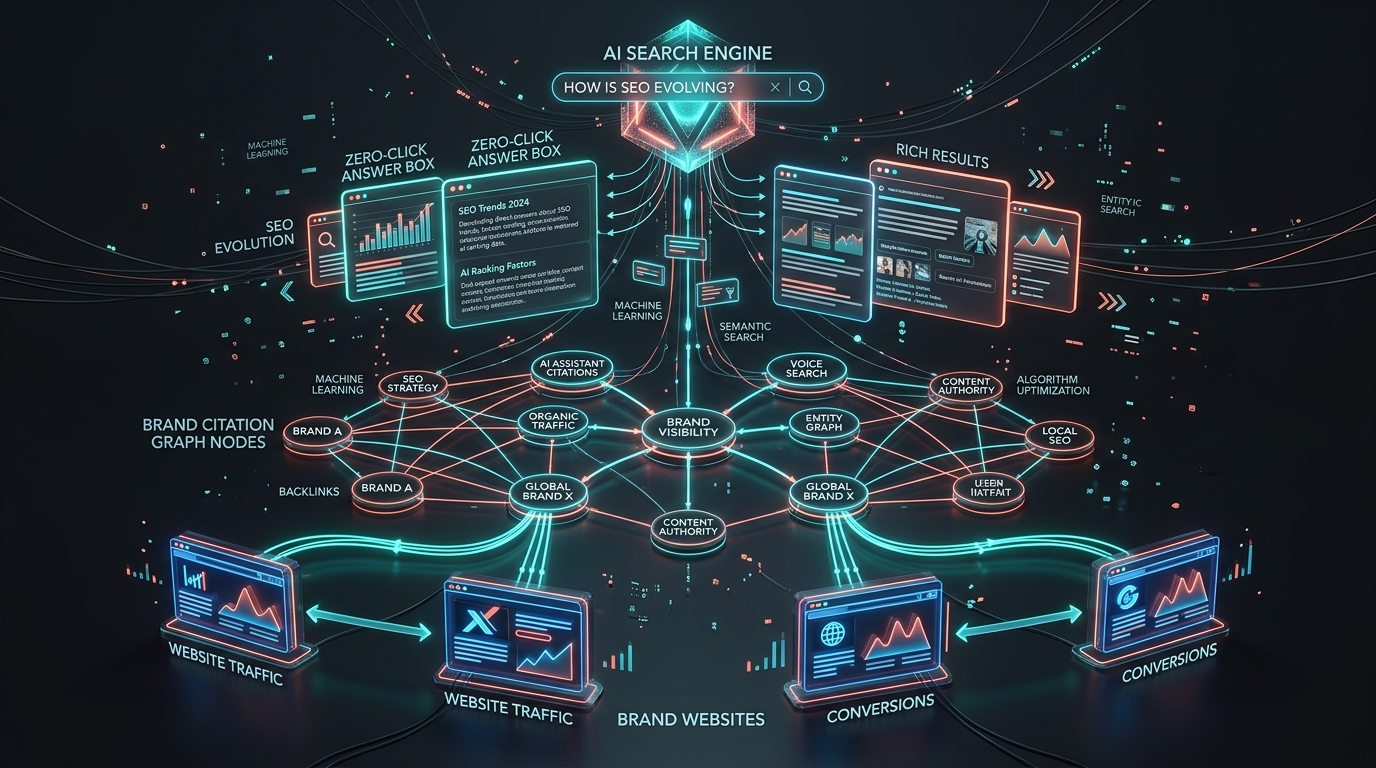 Source: Wonzly Growth Intelligence - Brand citation tracking across AI Overviews and LLM answer engines.
Anatomy of an AI Overview: How LLMs Synthesize Content Without Passing Clicks
To compete effectively in a zero-click environment, marketers and developers must understand the technical pipeline that powers modern search synthesis. When a user submits a prompt to Google or a dedicated AI search engine, the system does not simply match keywords against an inverted index. Instead, it utilizes Retrieval-Augmented Generation (RAG).
The search engine first retrieves the top 10 to 20 most authoritative web documents related to the query. Next, an LLM parses the retrieved documents, extracts the most concise and factual answers, validates the consensus across sources, and generates a coherent multi-paragraph summary. Finally, the system appends small source pills or citation links adjacent to the generated text.
Studies evaluating user interaction patterns on AI Overviews reveal that while the vast majority of users read only the synthesized text, the small percentage of users who do click on the cited source links represent exceptionally high-intent traffic. These users have already read the high-level summary and are seeking in-depth tools, pricing, or direct implementation assistance.
The RAG Synthesis Pipeline Breakdown
| Stage | Process Name | What Happens Under the Hood | Traffic & Visibility Outcome |
|---|---|---|---|
| 1 | User Query Processing | User inputs natural language prompt (e.g., "How to track dynamic QR codes in 2026"). | Search intent mapped to semantic embeddings. |
| 2 | Fast Vector Retrieval | Search engine fetches top 10 to 20 authoritative web pages using semantic similarity. | Only pages with high entity clarity and schema are pulled. |
| 3 | LLM Synthesis & Consensus | Model extracts facts, validates claims across sources, and drafts a coherent summary. | Raw facts displayed directly without requiring site visits. |
| 4 | Zero-Click Display & Citations | Instant answer rendered on SERP with clickable brand citation badges and pill links. | 83%+ zero-click rate; clicks pass exclusively to high-intent links. |
- Vector Embeddings: Content is parsed into semantic chunks and ranked by factual relevance and clarity.
- Source Verification: Engines cross-reference claims across multiple authoritative domains before synthesizing answers.
- Citation Placement: Prominently featured source badges receive higher post-summary click conversion rates.
- Direct Resolution: Definitional queries (such as currency conversions, dates, and simple definitions) experience near-100 percent zero-click rates.
The Information Gain Framework: How to Win Position Zero and Model Citations
In an ecosystem where AI models can instantly summarize generic text, commodity content has lost all commercial value. If your blog post simply rehashes the top three Google results, an LLM will summarize your text without attributing unique credit to your brand.
To earn citations within AI Overviews, content must demonstrate high Information Gain. Introduced in Google patent filings and confirmed by modern ranking algorithms, the Information Gain score measures how much novel, non-redundant information a webpage provides beyond what is already present in competing search results.
Publishers can maximize their Information Gain score by embedding proprietary research, original customer surveys, unique workflow benchmarks, case studies, and concrete data visualizations into every article. When your website is the sole original source of a specific statistic or methodology, the AI model is forced to cite your brand directly to preserve factual grounding.
- Proprietary Data: Conduct and publish original experiments, benchmark tests, and user behavior studies.
- Direct Definitions: Provide concise, 40 to 60 word factual answers immediately below major H2 headings to simplify model extraction.
- Original Analogies & Visuals: Develop unique conceptual diagrams and terminology that competitors lack.
- Named Entity Association: Clearly link your brand entity with specific industry concepts (such as "Wonzly link intelligence" or "dynamic redirect optimization").
Generative Engine Optimization (GEO) vs Traditional SEO in Practice
Generative Engine Optimization (GEO) does not replace traditional Search Engine Optimization (SEO); rather, it builds directly upon it. While traditional SEO focuses on keyword density, backlink quantity, and metadata tags, GEO focuses on semantic clarity, information structure, schema markup, and verifiable authority.
The table below highlights the fundamental differences between classic ranking strategies and modern AI optimization techniques:
| Optimization Dimension | Traditional SEO Focus | Generative Engine Optimization (GEO) Focus |
|---|---|---|
| Primary Goal | Rank in top 3 blue links to generate clicks | Get cited and recommended in AI answer synthesis |
| Core Metric | Organic Pageviews and Keyword Rank | Share of Model Voice (SOMV) and Citation Share |
| Content Strategy | High keyword volume and long-form filler | High information gain, clear data tables, concise answers |
| Technical Layer | Title tags, meta descriptions, sitemaps | JSON-LD schema, structured tables, semantic headings |
| User Behavior | Scroll through page to find answers | Instant comprehension on SERP with high-intent follow-up |
To execute GEO successfully, format your content with structured comparison tables, numbered step-by-step instructions, and bulleted takeaways. Large language models exhibit a strong algorithmic preference for structured data formats because they minimize extraction ambiguity and computational parsing overhead.
- Structured Tables: Use clear markdown tables for comparisons, feature lists, and statistical summaries.
- Bullet Lists: Group actionable recommendations into scannable lists containing 3 to 6 items.
- Structured Schema: Implement comprehensive
Article,FAQPage, andBreadcrumbListJSON-LD markup on every published URL. - Topical Clustering: Build interlinked content hubs to establish undeniable domain authority across your core subject matter.
Transitioning from Raw Pageviews to Share of Model Voice (SOMV)
As organic pageviews face structural headwinds, forward-thinking growth teams are redefining their Key Performance Indicators (KPIs). Tracking keyword rankings alone provides an incomplete picture of digital visibility when the number-one ranking URL receives 40 percent fewer clicks than it did two years ago.
The emerging standard metric for 2026 is Share of Model Voice (SOMV). SOMV calculates the percentage of conversational AI prompts and search queries within your industry where your brand, product, or research is actively cited or recommended in the generated output.
Measuring SOMV requires conducting automated weekly prompt benchmarking across major consumer models, including ChatGPT, Google Gemini, Claude, and Perplexity. By querying these engines with representative buyer prompts (such as "What is the best link management platform for SaaS?" or "How to track dynamic QR codes?"), brands can track their citation frequency relative to key competitors.
- Citation Frequency: The raw count of instances your domain is hyperlinked as a supporting reference.
- Recommendation Sentiment: Whether the AI engine presents your software as a top-tier recommendation or an afterthought.
- Assisted Conversions: Tracking downstream revenue generated by users who initially discovered your brand via an AI citation.
- Brand Search Volume: Monitoring increases in direct navigational searches (
yourbrand.com) spurred by AI visibility.

Multi-Channel Traffic Diversification: Building an Owned Audience
Relying exclusively on any single search engine for 100 percent of your customer acquisition pipeline is an unsustainable business risk in 2026. The brands thriving in the zero-click era are those that treat search engines as top-of-funnel discovery mechanisms while aggressively converting search visitors into owned audiences.
Owned channels provide direct, unmediated communication lines to your prospective and existing customers. These channels include email newsletters, dedicated community platforms, podcast feeds, and private developer forums.
When a user lands on your website from an organic search or AI citation, your immediate priority must be providing enough immediate value that they willingly subscribe to your owned communication ecosystem.
- Email Newsletters: Offer high-value weekly industry teardowns that cannot be summarized by a generic search engine.
- Interactive Web Tools: Provide free utilities, calculators, and generators that require hands-on user interaction.
- Direct Community Building: Host active discussions on Discord, Slack, or GitHub Discussions where members engage with peers.
- Social Media Native Content: Repurpose your core insights into native threads and short-form video on LinkedIn, X, and YouTube.
Learn more about evolving discovery models by exploring our comprehensive analysis on the rise of social SEO in 2026 and first-party data strategies after third-party cookies.
First-Party Link Infrastructure, Custom Domains, and Attribution
In an environment where traffic arrives through a fragmented web of AI Overviews, social platforms, private messaging apps, and email newsletters, accurate attribution becomes a critical challenge. If your marketing team cannot accurately trace which campaigns and distribution channels generate high-converting customers, your marketing budget is spent blindly.
Modern link management infrastructure is the backbone of multi-channel attribution. By utilizing custom branded short domains and standardized UTM parameter tracking, your business captures first-party analytics at the moment of redirection.
Wonzly Feature Spotlight: Wonzly gives businesses complete control over their link tracking and digital routing. With instant branded short links (
brand.link/guide), dynamic QR codes, real-time geographic and device telemetry, and automated webhook triggers, Wonzly turns every shared link into an intelligent data collection asset.
Multi-Channel First-Party Link Attribution Matrix
| Distribution Channel | Inbound Touchpoint | Wonzly Routing & Telemetry | Customer Journey & Conversion Outcome |
|---|---|---|---|
| AI Overview Citation | Clickable citation badge in answer | https://wonzly.link/ai-ref (Tracks model provider & OS) |
Routes to high-intent product feature page |
| Email Newsletter | Weekly teardown CTA button | https://wonzly.link/nl-aug (Logs subscriber cohort data) |
Direct access to gated whitepapers and tools |
| Social Thread | LinkedIn or X strategy breakdown | https://wonzly.link/tw-geo (Captures campaign UTM tags) |
Interactive calculators & benchmark app |
| Print Marketing | Dynamic QR code on conference banner | https://wonzly.link/qr-sum (Records city scan geolocation) |
Seamless mobile-optimized registration flow |
- Branded Link Authority: Custom domains improve link trust, boosting click-through rates by up to 34 percent compared to generic shorteners.
- Real-Time Click Telemetry: Monitor traffic volume, referrer sources, browser types, and geographic locations instantly.
- Dynamic Target Modification: Update destination landing pages on the fly without breaking links already cited in external materials.
- UTM Consistency: Maintain strict, standardized campaign attribution across every external distribution touchpoint.
Discover the technical foundations of modern redirect routing in our guide to link management infrastructure and what is a URL shortener.
Frequently Asked Questions (FAQ)
What exactly is a zero-click search?
A zero-click search occurs when a user enters a search query into a search engine like Google and finds their answer directly on the results page (via an AI Overview, featured snippet, or knowledge panel) without clicking on any external website links.
How much has organic search traffic dropped due to AI Overviews?
Studies in 2026 indicate that when an AI Overview is displayed, organic click-through rates for traditional ranking websites decline between 35 percent and 62 percent, depending on the industry and query complexity.
What is Generative Engine Optimization (GEO)?
Generative Engine Optimization is the practice of optimizing website content, structure, data tables, and schema markup so that generative AI models (such as ChatGPT, Google Gemini, and Perplexity) easily extract, cite, and recommend your brand in their synthesized answers.
What does "Information Gain" mean in modern SEO?
Information Gain refers to the unique, non-redundant value a webpage provides beyond what already exists on other ranking sites. Content with high information gain (such as proprietary data, original research, and unique case studies) is prioritized for AI citations.
What is Share of Model Voice (SOMV)?
Share of Model Voice is an analytics metric measuring the percentage of relevant industry queries and prompts where your brand or content is cited and recommended by major large language models relative to your competitors.
Why is first-party link tracking essential in a zero-click world?
Because traffic arrives through fragmented, non-traditional channels (like AI citations, direct messaging, and newsletters), first-party branded short links ensure accurate attribution, click telemetry, and redirect control without relying on third-party tracking cookies.
Ready to Master Your Multi-Channel Traffic?
As search engines evolve, your business needs robust, independent tools to manage, route, and track every digital interaction. Wonzly provides enterprise-grade URL shortening, dynamic QR code creation, and deep link intelligence designed for modern marketers.
- Start for Free Today -> Create Your Free Wonzly Account
- Explore Link Management Tools -> See Wonzly in Action
- Read More Growth Strategies -> Browse All Wonzly Blog Articles